Primary health care facility infrastructure and services and the nutritional status of children 0-71-months-old and their caregivers attending these facilities in four rural districts in the Eastern Cape and KwaZulu-Natal provinces, South Africa.
Keywords:
primary health care facilities, nutritional status, children, caregivers, rural, South Africa
Abstract
Objective: To assess primary health care (PHC) facility infrastructure and services, and the nutritional status of 0-71-month-old children and their caregivers attending these facilities in the Eastern Cape (EC) and KwaZulu Natal (KZN) provinces, South Africa. Design: Cross-sectional survey. Setting: Rural districts in the EC (OR Tambo and Alfred Nzo) and KZN (Umkhanyakude and Zululand). Subjects: PHC facilities and nurses (EC 20; KZN 20); children 0-71-months-old and their caregivers (EC 994; KZN 992). Methods: Structured questionnaires and anthropometric survey. Results: Of the 40 PHC facilities 14 were built or renovated after 1994. PHC facility access to basic resources was as follows; safe drinking water (EC 20%; KZN 25%), electricity (EC 45%; KZN 85%); flush toilets (EC 40%; KZN 75%) and operational telephones (EC 20%; KZN 5%). More than 50% of the nurses reported problems with basic resources and the existence of cultural practices as influencing the quality of services. Home deliveries were common (EC 41%; KZN 25%). Social grants were reported as a main source of income (EC 33%; KZN 28%). A few households reportedly had enough food at all times (EC 15%; KZN 7%). The prevalence of diarrhea as reported was high (EC 34; KZN 38%) and it was the leading cause of reported under-five deaths. Stunting in children 6-60 months (EC 23%; KZN 24%), and overweight/obesity in adults (EC 49%; KZN 42%) co-existed. Conclusion: Problems regarding infrastructure, basic resources and services adversely affect service delivery and the well-being of rural people and need attention.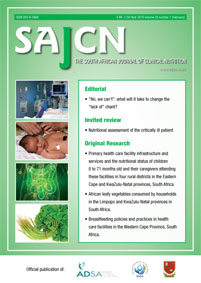
Published
2009-11-22
How to Cite
Schoeman, S., Smuts, C., Faber, M., Van Stuijvenberg, M., Oelofse, A., Laubscher, J., Benadé, A., & Dhansay, M. (2009). Primary health care facility infrastructure and services and the nutritional status of children 0-71-months-old and their caregivers attending these facilities in four rural districts in the Eastern Cape and KwaZulu-Natal provinces, South Africa. South African Journal of Clinical Nutrition, 23(1), 21-27. Retrieved from http://www.sajcn.co.za/index.php/SAJCN/article/view/347
Issue
Section
Original Research
Material submitted for publication in the South African Journal of Clinical Nutrition (SAJCN) is accepted provided it has not been published elsewhere. Copyright forms will be sent with acknowledgement of receipt and the SAJCN reserves copyright of the material published.
The SAJCN does not hold itself responsible for statements made by the authors.